Manual Joint Replacement – Dr. Vinit Oswal | Expert Orthopaedic
Doctor in Bengaluru
Dr. Vinit Oswal, a highly skilled Orthopaedic Surgeon at
Spire Clinic, Bengaluru, is an expert in
Manual Joint Replacement Surgery. With years of surgical experience and
precision,
he provides advanced care for patients suffering from severe arthritis, degenerative
joint conditions,
and complex joint deformities, ensuring effective pain relief and long-term mobility
restoration.
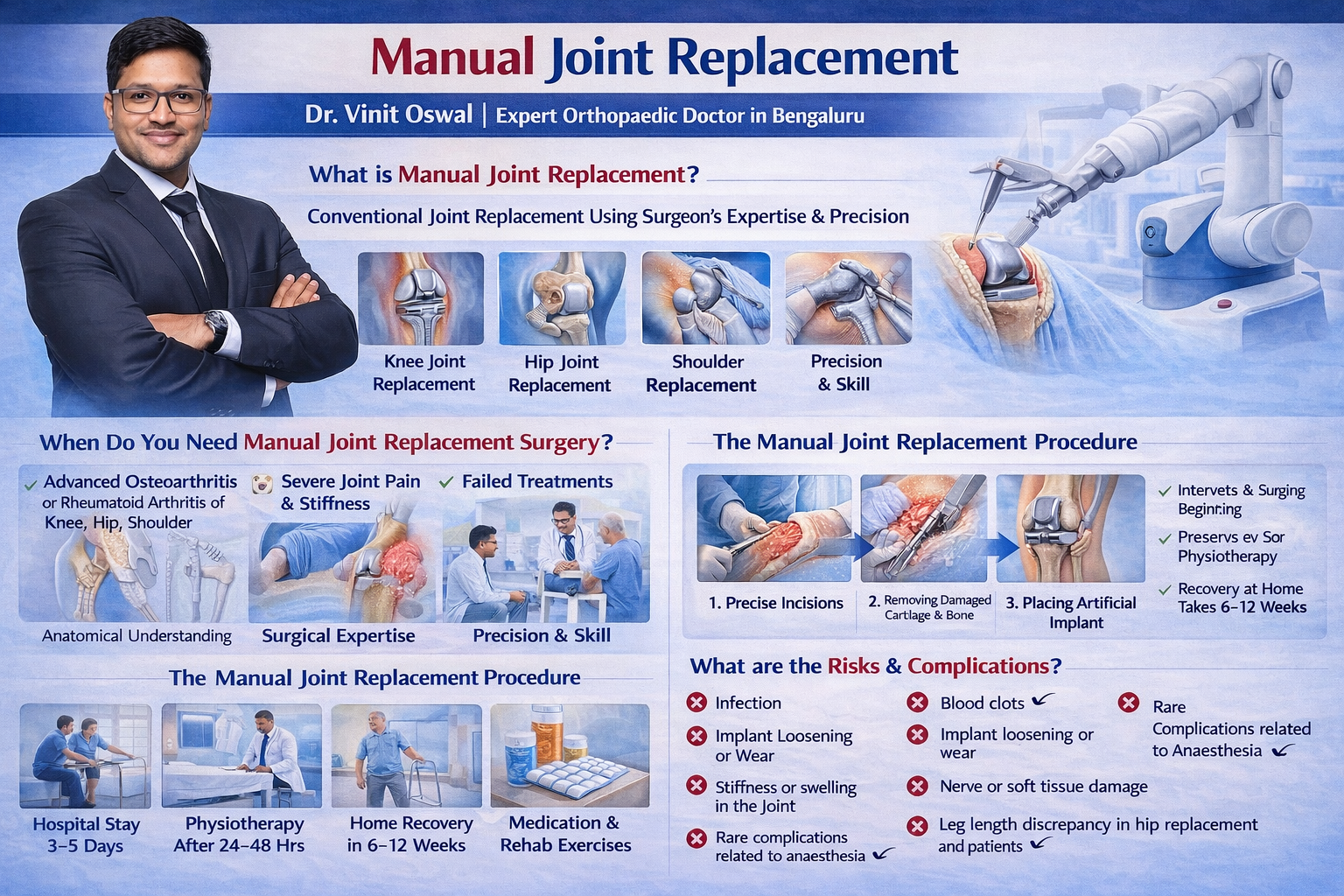
What is Manual Joint Replacement?
Manual Joint Replacement is a conventional orthopaedic procedure where the surgeon
replaces the
damaged surfaces of a joint (knee, hip, or shoulder) with artificial implants using
traditional
surgical techniques. Unlike robotic-assisted methods, the procedure relies on the
surgeon’s expertise,
anatomical understanding, and surgical precision to achieve accurate implant placement
and successful outcomes.
When should you have Manual Joint Replacement Surgery?
- Advanced osteoarthritis or rheumatoid arthritis affecting the knee, hip, or shoulder
- Severe joint pain and stiffness limiting mobility and daily activities
- Joint deformities such as bow legs, knock knees, or hip misalignment
- Failure of non-surgical treatments like medications, injections, or physiotherapy
- Cases where conventional surgery is more suitable than robotic-assisted procedures
How is the Manual Joint Replacement Procedure Done?
- Performed under general or spinal anaesthesia
- Surgeon makes precise incisions to access the damaged joint
- Cartilage and bone surfaces are removed manually with surgical instruments
- Artificial implants (metal and high-grade plastic) are positioned in the joint
- The surgery typically lasts 1–2 hours depending on the joint involved
- Procedure outcomes depend on surgeon’s skill, experience, and alignment accuracy
What Care is Necessary After a Manual Joint Replacement Surgery?
- Hospital stay usually lasts 3–5 days
- Physiotherapy begins within 24–48 hours to restore movement
- Patients can usually walk with support in 2–3 days
- At home, recovery takes 6–12 weeks depending on age and health
- Pain medications and anti-inflammatory drugs are prescribed
- Regular exercises and rehabilitation improve long-term outcomes
Post-surgery care includes maintaining a healthy diet, avoiding strain on the replaced
joint,
and following physiotherapy protocols. Regular follow-up visits with your orthopaedic
surgeon
are crucial for ensuring proper healing and implant stability.
What are the Risks & Complications?
- Infection
- Blood clots
- Implant loosening or wear over time
- Nerve or soft tissue damage
- Stiffness or swelling in the joint
- Possible leg length discrepancy in hip replacement
- Rare complications related to anaesthesia
What are Some Advantages of Manual Joint Replacement?
- Proven technique with decades of successful outcomes
- Lower cost compared to robotic joint replacement
- Wide availability in most orthopaedic hospitals
- Effective pain relief and improved mobility
- Correction of deformities in hips, knees, or shoulders
- Durable results with implants lasting 15–20 years
- Enhanced quality of life and independence for patients
Book Your Appointment
For additional information on Manual Joint Replacement surgery, or to
have your
joint pain evaluated, please call
+91 6364329177 – Dr. Vinit Oswal, Expert
Orthopaedic
Doctor in Bengaluru, serving patients at Spire Clinic and across Bangalore City.






.png)
.png)
.png)


.png)
.png)
.png)